The construction industry is undergoing a paradigm shift. Faced with the need to build faster, more sustainably, and more efficiently, traditional methods are being replaced by industrialization. In this piece, we take an in-depth look at modular and prefabricated construction, demystifying concepts and exploring their future potential.
First things first, as the saying goes: "all modular homes are prefabricated, but not all prefabricated homes are modular." Understanding the technical difference between the two terms is a good starting point.
#Prefabrication: It's the how, the umbrella term. It refers to any process where components of a structure are manufactured in an industrial facility (off-site) and then transported to the construction site for final assembly. This can range from a simple concrete beam to an entire wall.
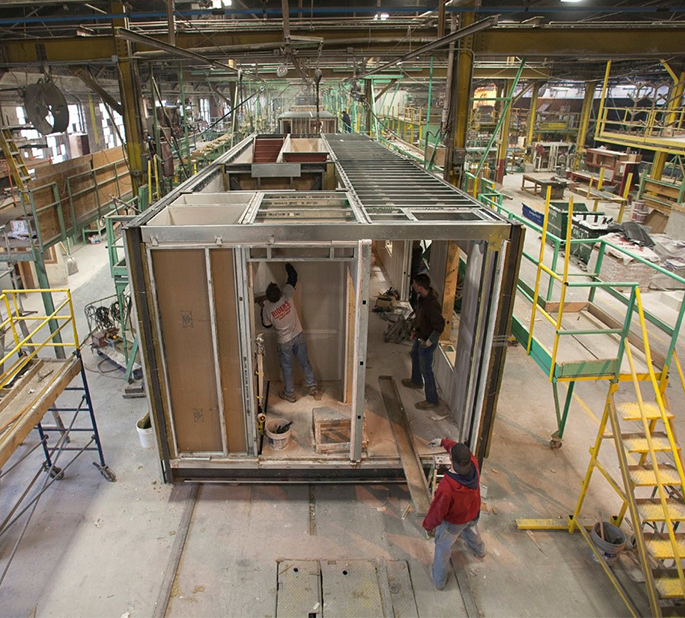
#Modular construction: It's the what, and refers tothe most advanced level of prefabrication, often called "volumetric construction." Here, the factory produces complete three-dimensional units (modules), such as an entire room with a bathroom, utilities, and finishes already in place. These modules are stacked and connected on-site like giant LEGO bricks.
While standard prefabrication may involve shipping flat panels (2D), modular construction involves shipping complete spatial volumes (3D).
Why the industry is pivoting to the factory
Moving construction to a controlled environment offers benefits that traditional on-site work can hardly match. To mention a few:
#1-Time and cost efficiency (parallel processes): While foundations and earthworks are being carried out on-site, the building is simultaneously being constructed in the factory. This can reduce project delivery times by up to 30-50%, accelerating the return on investment.
The speed of this system makes it ideal for hospitality and student residences, where unit repetition (rooms) is high, affordable housing to respond quickly to the housing crisis, and healthcare centers, where speed of execution is critical.
#2-Superior quality and control: Say goodbye to rain delays. Production in a covered, controlled environment allows for rigorous supervision, ensuring uniform quality and millimeter tolerances while drastically reducing post-sale defects.
#3-Environmental sustainability: It is cleaner construction, which translates to material optimization, on-site waste reduction, reduced water and energy consumption, and less noise and environmental impact on the destination neighborhood.
#4-Occupational safety: Shifting work from an unpredictable construction site to an organized factory significantly reduces the risks of workplace accidents, falls, and exposure to inclement weather.
The challenges ahead
Despite significant momentum, several barriers still slow widespread adoption. Here are some examples:
#1-Logistics and complex transport: The Achilles' heel. Transporting large volumetric modules requires detailed planning, special permits for wide loads, and the use of heavy-tonnage cranes for on-site assembly, which can significantly increase project costs.
#2-Initial design rigidity: Although the design is flexible at the start, once manufacturing begins, changes are costly and difficult to implement. It requires a much earlier definition of the project than traditional construction (where changes are often made on the fly).
#3-Financing and regulations: Banking systems and municipal rules are often designed for traditional construction. Obtaining mortgages, insurance, and building permits for modular projects can be slower and more complex in certain regions.
#4-Cultural stigma: There is still a misconception in certain sectors that "prefabricated" is synonymous with low quality or temporary structures—a legacy of old emergency housing. Educating the market is vital.
Technology: The engine behind the shift
Modular construction would not be possible without Industry 4.0: This implies:
#BIM Integration (Building Information Modeling): This is the brain of the operation. BIM allows for the creation of a "digital twin" of the building before a single piece is manufactured. It ensures that all disciplines (structure, utilities, architecture) fit together perfectly, eliminating conflicts before reaching the production line.
#Robotics and automation: Modern factories use robotic arms for high-precision tasks such as material cutting, structural welding, or adhesive application, increasing speed and consistency.
#3D Printing: Although still incipient on large scales, it is revolutionizing the creation of complex, customized components with unique geometries that would be impossible with traditional methods, reducing material waste to almost zero.
Modular and prefabricated construction are no longer just "alternatives"; they are shaping up to be the most viable solution to face the global housing crisis and the need for fast, sustainable infrastructure. Despite logistical and regulatory challenges, the industrialization of the sector is inevitable. For it to succeed on a large scale, a change of mindset is required: stop thinking about "building on-site" and start thinking about "assembling manufactured products."

