We're being flooded with AI content, and we've grown tired of its many iterations. But when we talk about AI, its generative function is just the tip of the iceberg. Recently, AI has become ubiquitous in professionals' workflows across many fields, boosting efficiency and streamlining most processes. So, in Corbis, we decided to put that to the test.
In Corbis, rather than fearing AI, we embrace it as a powerful tool in our working processes. After thorough testing, the results looked promising. It delivered better results and clear improvements in three key areas: program configuration, efficiency, and error reduction.
Our main goal was to digitize a catalog within a BIM model using an Excel file as our unique reference. The task required us to take any product pre-modeled as a wall in Revit and cross-reference all its technical parameters. After a prolonged back-and-forth with the model, we configured a clear set of guidelines for its work and finally hit the sweet spot.
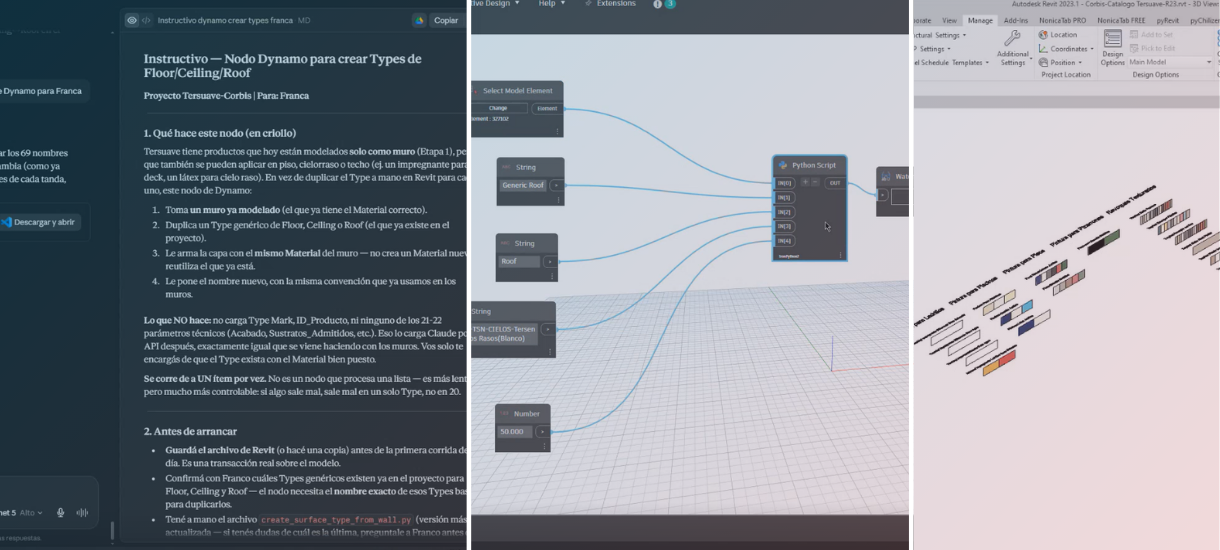
One of our top workflow priorities was to give the model clear, well-defined prompts in a controlled, calculated environment to prevent the AI from pulling information from unreliable sources. We used Claude Desktop and Nonica Tab Pro to connect the model to the BIM environment and ensure it worked as an agent. This means it would only perform independently, interpret rules, make decisions, and take action if we, as its human conductors, allowed it to.
By integrating an AI model into this process, we enhanced its accuracy by reducing many fatigue‑related mistakes. To do so, we first identified all possible mistakes and fed them to the model with a clear description of what each mistake consisted of. Again, although the model yielded positive results, it was crucial to provide keen, objective, and professional supervision of the tasks assigned to the AI.
Another interesting result involved the team's performance. Using the AI agent, we reduced time spent on most tasks by a third, with quality control as the most notable improvement. In other words, our AI agent, with customizable parameters, gave our teams a significant efficiency boost in time management and feasibility.
Overall, generative and agentic AI applied to our workflows allowed BIM processes to be smartly coordinated with predictive analysis. All while ensuring a strong link between information sharing and decision-making, under the supervision of a professional architect. There is still room for improvement, and our team is ready to keep testing technology to perfect project delivery.

